gastroenterologist

Saying Thank You to Patients

The year was 1990. I was in Detroit, Michigan working as a resident physician in Internal Medicine. Detroit was dilapidated, its old structures were crumbling, boarded up unkempt houses in neighborhoods once humming with life were now empty, desolated, overgrown with weeds. Brick walls of the old houses, once rock-solid were now fragile and cracked, in some of which parasitic plant lives had found foothold telling the story of once mighty Motor City. A drive through such neighborhoods evoked an unknown anxiety and fear that was only interrupted by sight of an occasional industrial park, equally gloomy, in disrepair, hauntingly desolate, behemoth brick buildings with broken glass windows and ragged pitched roofs still oozing melted snow, as if only kept alive in this state of coma by some unknown force just to remind people of the old industrial glory of Detroit. Coming from Bangladesh, an overpopulated country of 2000 people per square miles, it was terribly lonely for me not to see any people on the streets and neighborhoods deserted whereas in my home country it was hard to see an inch of empty spot devoid of humans. I was struggling in my conscious and subconscious to reconcile and digest the contrast. Loneliness that I found impossible in Bangladesh, now in Detroit was over abundant and almost overwhelming. Demand of residency training, both physical and mental vigor that is called for from a young trainee doctor, kept me busy and had distracted me somewhat, perhaps even protected me from the malady of loneliness. Working in a large urban medical school training program I needed to rotate through many different hospitals. Allen Park Veterans Administration Hospital and Medical Center was one such a place. Allen Park, twenty minute South and West of Detroit was a small working class community of Downriver area. Houses were small but neat, yards were tiny yet tidy. The imposing structure other than nearby shopping mall was the VA Hospital. As I drove the very first day of internship towards this hospital, the first sight of the sprawling red-brick building stuck right next to the freeway, with its multi-floored structure and hundreds of small panes of glass windows on all sides seemed like I was being watched by a giant alien with hundreds of eyes looking out over the plains. The sight was overpowering. As I approached the building close, the billowing cloud of smoke from the smoking veterans on both sides of the entrance outside greeted me with an aura of Burmese Opium Den. But time is a great healer; distance is the halcyon; work is the opium; my old familiar sights and sounds from the home country of Bangladesh faded gradually, and soon realities and demands of current surroundings took the center stage. Curious part of my brain sprang back into action again, perhaps I subconsciously realized it to be a healthy distraction from the monotonous grueling work of patient care at the VA Hospital. Often in call nights, I would look through the cracks and crannies of the old hospital building noticing the fine color difference of the two buildings put together, the subtle difference of the pinkish bricks, the variation of the poured concrete, the rusted iron rods sticking out as if I was driven by an impulse to find an old skeleton hidden somewhere. There are times at night I would circumnavigate the old buildings as if I were the Columbus on a mission to discover America. The reason behind as to why the Federal government put this huge hospital in such a place outside the city limits of Detroit was simply another Henry Ford story. In the dark days of Great Depression of the 1930s, the Ford family had donated 38 acres of land to the federal government in Allen Park, MI, as an inducement to set up this VA hospital. The construction work began in 1937. At the end of Second World War as the rank of Midwestern veterans swelled, the hospital was expanded in phases to accommodate the increasing demand. The architects in charge of these renovations never wanted to hide this fact perhaps, because any observant set of eyeballs could easily still tell each additions of the hospital separately. This VA Hospital was gem of a place to learn for any aspiring medical student. Veterans and the teaching faculties were always easy going compared with elite private hospitals and sophisticated patients therein. Veterans on the other hand, did not have any special demand upon the trainees. VA Patients were always compliant and unabashed at the request of physical examination and as of yet, neither there was the looming threat of malpractice law suits, nor there was any pressure from the administration to discharge anyone early to save the hospital money. In fact the pressure was opposite: to keep patients in the hospital for any reason as long as one can, medical to social. It was not unusual to keep someone for days even weeks in the inpatient hospital service because the veteran had no taxicab fare or bus ride to go home. Apparently each individual VA Hospitals used to get budgeted money allocation according to the census of the hospital. The more patients each hospital had in its rolls the more money were to be allocated. I remember one day, the chief of the hospital came in our morning round and told us to “keep as many patients in hospital as you can so our census goes up since the budget allocation time is coming up”! Inside the mammoth building it was gloomy dark with old fixtures. The walls were old and bare, as if the building was missing the touch of a woman and truly it was devoid of women at that time. In my whole time of service over several years, I only got to see two or three female veterans in this hospital. The whole hospital building was made for only men by men. The rare female veterans who were to be admitted were

Saying Thank You to Patients Read More »
Remote Medicine, How to make it Up-close & Personal

Now that we are in the midst of Covid 19 Virus lockdown, for non-emergent consults and follow ups, telemedicine via chat and video technologies are the only options for physicians and patients. In the absence of direct eye contact, how do I, as a physician, connect to patients? This is a tall order even in “normal times” when all the doctor visits are face to face. Lack of connecting with doctors or other providers of care and finding a lack of personal connection is one of the common reasons for dissatisfaction, lack of trust and compliance of the patients. The very basis of a treatment plan that we are taught from day one in medical schools around the world is “History and Physical (examination)”. In the remote medicine practiced through the technologies, a precise head to toe physical examination is not possible, so history, or better said, story is very important. In my experience, connecting with a patient at a personal level is not only important for the patient, but also for the physician. I always find better job satisfaction in connecting with a patient or for that reason, any human at a very personal level. In my own practice, after initial few days of struggle and discomfort, I have found a way to connect with my patients in a deeper level. This is very simple: asking them an open ended question to convey the message that I as a doctor am interested in them. So after the initial introduction to each other, I ask them, “Tell me about yourself”. Some of them may not still get my question, since they are not used to this and will go about describing their medical issues. In that case I emphasize, “Tell me about yourself as a human, so I get to know you as a person, tell me where were you born, how was your growing up like, who and what are important to you? What do you do for a living?” This simple method of storytelling and story listening changes the whole atmosphere and nature of the whole visit. I notice the tone and tenor of the medical encounter change right away. It makes a positive energy flow not only with the patient, but also in myself as a human. Storytelling and story listening are the most unique human attributes of human nature. This is the main reason for the triumph of our species over other species who grew up and roamed together in the plains of Africa for thousands of years according to author and historian Yuval Noah Harari. This is the main reason why millions of us can cooperate together even without intimately knowing each other. So storytelling and listening are the very life-blood of humanity and we need it more so in sickness and more of it when we are sick and vulnerable. Faced with such an welcome in the physician interview, many of my patients are open to give an immediate feedback. One such patient told me, “I am 71 year old and no doctor ever asked me to know about me!” Another of my patients told me, “This is the first time a doctor showed interest in me as a person”. In my mind, getting personally connected with a patient has benefits in several folds: 1. a personal connection with the doctors provide better mental satisfaction on the part of the patient, who naturally puts trust the doctor. 2. Patients see better value in their encounter. 3. With such feelings they are more likely to stick by the management plan of the physician. 4. It provides greater job satisfaction for the doctor himself. Physician burnout has been a much discussed issue for several years and this might be one of the ways to reduce the burnout rate. 5. It increases reputation and goodwill of the practice. Remote Medicine or Telemedicine as it is called popularly, had had a slow start until the Covid 19 pandemic upended everything in our world. Flexibility on patient care and management and keeping an open mind will be crucial now as we embrace or are compelled to embrace the new technologies for delivering patient care. We have to be more creative and imaginative than ever before to get to know our patients and in connecting with them in absence of direct eye contact, touch and feel of the physician.

Remote Medicine, How to make it Up-close & Personal Read More »

Age of TeleMedicine

With the Coronavirus Crisis, we are enduring the modern Plaque of our times. Here in the United States, 30 of the 50 States have declared strict social distancing as of this date of writing. This order stopped all work of outpatient surgical facilities and also stopped the regular patient visits to the doctors’ offices making the the nation increasingly dependent on tele-medicine, or remote medicine by using video or other chat technologies. Studies on US patients show that even in normal times a significant percentage of patients are unhappy with the encounter experiences. With the introduction of computer technologies and EHR, some feel increasing impersonal and mechanical atmosphere of the sacred doctor-patient relationship, the basis of which is so personal in nature. This feeling now will accentuate to a higher degree given the providers and the patients are not even in the vicinity of each other. In absence of direct eye contact and touch of physicians or providers, I am afraid the dissatisfaction will sky-rocket. At the same time, we should not discount the advantages of remote medicine and look for ways to mitigate the disadvantages of such remote encounters. Remote medicine is a great way to reduce one of the main complaints of American patients: waiting time. Since patients are in their own environment either at their own homes or offices, doing what they normally do, this is an area we can see immediate improvement. We also have to look at favorably the productivity of the patient by not spending time in the physician offices or hospitals. In addition, exposure to infectious and contagious diseases will be minimized by remote medicine. With respect to mitigation of lack of physical exam and touch and feel of the physician, there is no true replacement and serious patients must still be examined by the provider. But one way to mitigate the disadvantages of remote medicine is physicians have to better story listeners and better storytellers. Each patient is an open storybook. Physicians just have to read it. I am an advocate of replacing the age old medical school slogan of “History and physical” to “Storytelling and Story Listening”. The reason storytelling is important because in my experience I find that physician has his/her own story to tell first to make the patient comfortable. This is a great signal to a vulnerable individual that physician/ provider is a human and it is the best reassurance and encouragement for patients to open up about her/his own story. In my own remote or person to person encounter, after initial introduction, I often start the interview by an open ended question, “Tell me your story……..” And this gives the patient on the other side of the line or sitting on the other chair to start with whatever they want. And often times people will start with something that is important to them or something that is bothering them the most. As the conversation starts, I find something of my personal life to share with them….. thus a patient’s story becomes one with a doctor’s story and it becomes a human story. By the time it ends, we both have an insight to our mutual connections as our doctor-patient relationship solidifies and a satisfactory treatment plan is built upon this solid foundation. In my experience, patient satisfaction and compliance is far superior in this way. But this is also a self-service for the provider. Self-service because as providers we also need to feel content and satisfied about what we do and by doing it better. So this is a way to derive fulfillment about our own job. Most importantly, the intangible benefit a physician derives by connecting with her/his patients is immense, far beyond what money can buy. So in the days of remote medicine and artificial intelligence, provider communities have to be far better storytellers and story listeners. Followings are few examples how my patients told their own stories and at times even gave me away the diagnosis. In 100 percent of times though, they gave me an opening to their lives and a great way to connect: A 48 year old woman; “How anxious I am to learn what is causing my pain. I have been on a liquid diet for more than a week, afraid of having another painful episode and returning to the ER”. This is in the background of upper abdominal pain. A 66 year old woman: “I am getting too many chicken eggs!” This is after successful treatment of blockage of the esophagus. A 59 year old female: “That my mother had a stroke in a catheterization lab and this procedures scares me because of that. But due to my faith, I believe that I’m going to be fine and back at my house eating chicken burgers, BBQ ribs, green beans etc!” This is in the perspective of a colonoscopy exam. A 56 year male: “Get up in the middle of night with panic attacks when I can’t breathe. Using Wal-four Nasal Spray all day long”. This is in the background of an upper abdominal pain. A 65 year old male: “My favorite color is blue, I love my wife more than life itself and my children are my strength. I need to exercise and eat better, I want to live as long as my great grand parents did at 103 and 105 years of age. I love life and believe in Jesus Christ who is with me today as I go through this procedure of life….. This is in the background of bleeding from colon. A 18 year old male: “I like spicy food” This is in the background of reflux and upper abdominal pain.

Age of TeleMedicine Read More »

Am I Wrong or Am I Right?

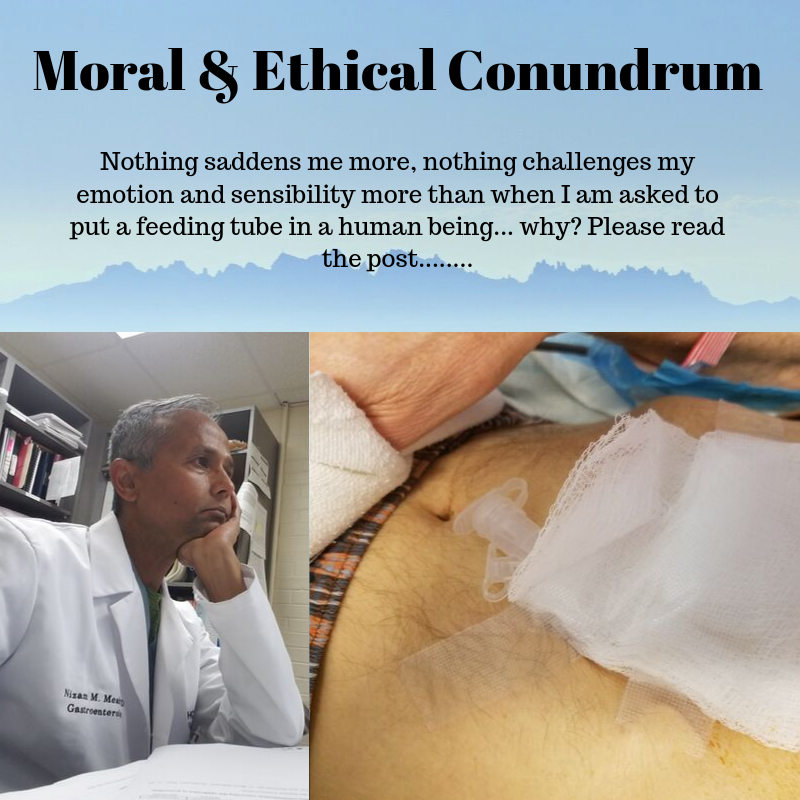
Nothing pains me as much or nothing burdens me as much except when I am faced with the decision of putting a FEEDING TUBE device in a human being. One might question: as a gastroenterologist I am trained to do this, I have done lots of them and also it is not that the procedure is particularly more dangerous than any others that I do. Yes, technically speaking it is easy for me, I have not found it more dangerous than many other things that I do in my day to day practice. Yet, at a human level I find it to be extremely difficult. People who need feeding tube often have lost control over their lives either by stroke, Alzheimer’s, cancer, accidents or other major life-changing events. Lot of them cannot even communicate, living in a state of either in coma or in persistent vegetative state. People who are lucky in such circumstances, relatively speaking, have family members available, in others it might be an administrative decision and even at times a court order. It reminds me of the very basic helplessness and vulnerability that we have as humans. Perhaps my own subconscious does not like that reminder in such a vivid way. Then again, how do I know I am making the right decision to put the tube in or even in declining in doing so? I know the consequences of not feeding: slow agonizing death, slow dehydration, malnutrition, slow shut down of the vital organs one by one. I also know if I put the feeding tube in, true we have a way of administering medicine and food, but still it may do nothing with relation to the original condition that led to such a situation. Some might say, such a human would still not live the full potential of life. Yet, who am I to make a decision about what quality of life another human should have? In times like this I feel the full burden of human limitations, imperfections and lack of prescience.  But I know that paralysis is not the answer either. I have to make a decision as a physician based on my past and present knowledge and to the best of my judgment, or, using the language of law, “using reasonable medical judgment”. Again, not all cases are so difficult. In some cases, perhaps a family or a friend would tell me a little story about such a person that sheds light to her choices of life, what she wanted, what he or she liked and disliked in the past. Sometimes, patient will leave a letter or a will clearly delineating what she would want. Easiest one will be the one who has a loving family member and who can relate to the disabled personal at a very emotional level. At times I will have supportive kin or caregiver. At times I just have to make the decision summoning all my inner strengths. At times even in the midst of such tragic cases, there are happy endings, not all are gloom and doom. So let me finish my current story with such a fairy tale but true story: just last week, such a human patient was brought to my office from nursing home accompanied by his brother. In my office, the human patient was in wheel chair, not making any eye contact, he had words but not purposeful and neither making any sense to a human with limited perception like me, a doctor. The nursing home staff and brother told me that he has been living in nursing home after the major heart attack he had about a decade ago and went to cardiogenic shock. Although he was revived, due to lack of oxygen, his brain suffered irreversible damage and he was not able to freely move or take care of his daily needs anymore. Since that time he has been living in nursing home and doing reasonably well. He seemed to get across his brother very well and each week, the brothers will go out and eat and watch a movie together. Sometimes after the matinee show, the two brothers will go for a wheel chair stroll on the nearby shores of Gulf of Mexico and Galveston Bay. At the end his brother will drop him off. For last three months, he developed difficulty of swallowing food. He seemed to be hungry but just not being able to eat. Nursing home and brother wanted to give him some times thinking it could be a temporary situation, but his condition went downhill without any reversal leading to more weakness and severe weight loss. I could do no meaningful communication with the patient himself and on my physical examination he had all the telltale signs of recent weight loss, dehydration and malnutrition. I found no contra-indication of placing the feeding tube.  Technically and medically speaking, he was an appropriate candidate for Percutaneous Gastrostomy Tube or stomach feeding tube placement. At this time only issue to reconcile with the ethical and human issues associated with the medical procedure. In another word to put myself in the shoes of the patient and sort out if the patient would have really wanted it or not or is it in the best interest of the patient. I wanted to gain more insight into the patient, his past and present. I started speaking with the brother, the only line of communication I had with the patient. He reminisced from the childhood memories of their growing up together in the expansive geography of West Texas. The two brothers grew up in a farm, with nearest neighbor eighteen miles away. They spent times in fishing, hunting and also getting into mischief. In such a desolate land, the two brothers were best friends. When his brother, our patient, had the heart attack and subsequently became disabled, the other brother brought him back from West Texas to South Texas, a distance of 10 hours of driving and settled him in nearby

Am I Wrong or Am I Right? Read More »