doctor

healing story

Saying Thank You to Patients

The year was 1990. I was in Detroit, Michigan working as a resident physician in Internal Medicine. Detroit was dilapidated, its old structures were crumbling, boarded up unkempt houses in neighborhoods once humming with life were now empty, desolated, overgrown with weeds. Brick walls of the old houses, once rock-solid were now fragile and cracked, in some of which parasitic plant lives had found foothold telling the story of once mighty Motor City. A drive through such neighborhoods evoked an unknown anxiety and fear that was only interrupted by sight of an occasional industrial park, equally gloomy, in disrepair, hauntingly desolate, behemoth brick buildings with broken glass windows and ragged pitched roofs still oozing melted snow, as if only kept alive in this state of coma by some unknown force just to remind people of the old industrial glory of Detroit. Coming from Bangladesh, an overpopulated country of 2000 people per square miles, it was terribly lonely for me not to see any people on the streets and neighborhoods deserted whereas in my home country it was hard to see an inch of empty spot devoid of humans. I was struggling in my conscious and subconscious to reconcile and digest the contrast. Loneliness that I found impossible in Bangladesh, now in Detroit was over abundant and almost overwhelming. Demand of residency training, both physical and mental vigor that is called for from a young trainee doctor, kept me busy and had distracted me somewhat, perhaps even protected me from the malady of loneliness. Working in a large urban medical school training program I needed to rotate through many different hospitals. Allen Park Veterans Administration Hospital and Medical Center was one such a place. Allen Park, twenty minute South and West of Detroit was a small working class community of Downriver area. Houses were small but neat, yards were tiny yet tidy. The imposing structure other than nearby shopping mall was the VA Hospital. As I drove the very first day of internship towards this hospital, the first sight of the sprawling red-brick building stuck right next to the freeway, with its multi-floored structure and hundreds of small panes of glass windows on all sides seemed like I was being watched by a giant alien with hundreds of eyes looking out over the plains. The sight was overpowering. As I approached the building close, the billowing cloud of smoke from the smoking veterans on both sides of the entrance outside greeted me with an aura of Burmese Opium Den. But time is a great healer; distance is the halcyon; work is the opium; my old familiar sights and sounds from the home country of Bangladesh faded gradually, and soon realities and demands of current surroundings took the center stage. Curious part of my brain sprang back into action again, perhaps I subconsciously realized it to be a healthy distraction from the monotonous grueling work of patient care at the VA Hospital. Often in call nights, I would look through the cracks and crannies of the old hospital building noticing the fine color difference of the two buildings put together, the subtle difference of the pinkish bricks, the variation of the poured concrete, the rusted iron rods sticking out as if I was driven by an impulse to find an old skeleton hidden somewhere. There are times at night I would circumnavigate the old buildings as if I were the Columbus on a mission to discover America. The reason behind as to why the Federal government put this huge hospital in such a place outside the city limits of Detroit was simply another Henry Ford story. In the dark days of Great Depression of the 1930s, the Ford family had donated 38 acres of land to the federal government in Allen Park, MI, as an inducement to set up this VA hospital. The construction work began in 1937. At the end of Second World War as the rank of Midwestern veterans swelled, the hospital was expanded in phases to accommodate the increasing demand. The architects in charge of these renovations never wanted to hide this fact perhaps, because any observant set of eyeballs could easily still tell each additions of the hospital separately. This VA Hospital was gem of a place to learn for any aspiring medical student. Veterans and the teaching faculties were always easy going compared with elite private hospitals and sophisticated patients therein. Veterans on the other hand, did not have any special demand upon the trainees. VA Patients were always compliant and unabashed at the request of physical examination and as of yet, neither there was the looming threat of malpractice law suits, nor there was any pressure from the administration to discharge anyone early to save the hospital money. In fact the pressure was opposite: to keep patients in the hospital for any reason as long as one can, medical to social. It was not unusual to keep someone for days even weeks in the inpatient hospital service because the veteran had no taxicab fare or bus ride to go home. Apparently each individual VA Hospitals used to get budgeted money allocation according to the census of the hospital. The more patients each hospital had in its rolls the more money were to be allocated. I remember one day, the chief of the hospital came in our morning round and told us to “keep as many patients in hospital as you can so our census goes up since the budget allocation time is coming up”! Inside the mammoth building it was gloomy dark with old fixtures. The walls were old and bare, as if the building was missing the touch of a woman and truly it was devoid of women at that time. In my whole time of service over several years, I only got to see two or three female veterans in this hospital. The whole hospital building was made for only men by men. The rare female veterans who were to be admitted were

Saying Thank You to Patients Read More »
Remote Medicine, How to make it Up-close & Personal

Now that we are in the midst of Covid 19 Virus lockdown, for non-emergent consults and follow ups, telemedicine via chat and video technologies are the only options for physicians and patients. In the absence of direct eye contact, how do I, as a physician, connect to patients? This is a tall order even in “normal times” when all the doctor visits are face to face. Lack of connecting with doctors or other providers of care and finding a lack of personal connection is one of the common reasons for dissatisfaction, lack of trust and compliance of the patients. The very basis of a treatment plan that we are taught from day one in medical schools around the world is “History and Physical (examination)”. In the remote medicine practiced through the technologies, a precise head to toe physical examination is not possible, so history, or better said, story is very important. In my experience, connecting with a patient at a personal level is not only important for the patient, but also for the physician. I always find better job satisfaction in connecting with a patient or for that reason, any human at a very personal level. In my own practice, after initial few days of struggle and discomfort, I have found a way to connect with my patients in a deeper level. This is very simple: asking them an open ended question to convey the message that I as a doctor am interested in them. So after the initial introduction to each other, I ask them, “Tell me about yourself”. Some of them may not still get my question, since they are not used to this and will go about describing their medical issues. In that case I emphasize, “Tell me about yourself as a human, so I get to know you as a person, tell me where were you born, how was your growing up like, who and what are important to you? What do you do for a living?” This simple method of storytelling and story listening changes the whole atmosphere and nature of the whole visit. I notice the tone and tenor of the medical encounter change right away. It makes a positive energy flow not only with the patient, but also in myself as a human. Storytelling and story listening are the most unique human attributes of human nature. This is the main reason for the triumph of our species over other species who grew up and roamed together in the plains of Africa for thousands of years according to author and historian Yuval Noah Harari. This is the main reason why millions of us can cooperate together even without intimately knowing each other. So storytelling and listening are the very life-blood of humanity and we need it more so in sickness and more of it when we are sick and vulnerable. Faced with such an welcome in the physician interview, many of my patients are open to give an immediate feedback. One such patient told me, “I am 71 year old and no doctor ever asked me to know about me!” Another of my patients told me, “This is the first time a doctor showed interest in me as a person”. In my mind, getting personally connected with a patient has benefits in several folds: 1. a personal connection with the doctors provide better mental satisfaction on the part of the patient, who naturally puts trust the doctor. 2. Patients see better value in their encounter. 3. With such feelings they are more likely to stick by the management plan of the physician. 4. It provides greater job satisfaction for the doctor himself. Physician burnout has been a much discussed issue for several years and this might be one of the ways to reduce the burnout rate. 5. It increases reputation and goodwill of the practice. Remote Medicine or Telemedicine as it is called popularly, had had a slow start until the Covid 19 pandemic upended everything in our world. Flexibility on patient care and management and keeping an open mind will be crucial now as we embrace or are compelled to embrace the new technologies for delivering patient care. We have to be more creative and imaginative than ever before to get to know our patients and in connecting with them in absence of direct eye contact, touch and feel of the physician.

Remote Medicine, How to make it Up-close & Personal Read More »

Age of TeleMedicine

With the Coronavirus Crisis, we are enduring the modern Plaque of our times. Here in the United States, 30 of the 50 States have declared strict social distancing as of this date of writing. This order stopped all work of outpatient surgical facilities and also stopped the regular patient visits to the doctors’ offices making the the nation increasingly dependent on tele-medicine, or remote medicine by using video or other chat technologies. Studies on US patients show that even in normal times a significant percentage of patients are unhappy with the encounter experiences. With the introduction of computer technologies and EHR, some feel increasing impersonal and mechanical atmosphere of the sacred doctor-patient relationship, the basis of which is so personal in nature. This feeling now will accentuate to a higher degree given the providers and the patients are not even in the vicinity of each other. In absence of direct eye contact and touch of physicians or providers, I am afraid the dissatisfaction will sky-rocket. At the same time, we should not discount the advantages of remote medicine and look for ways to mitigate the disadvantages of such remote encounters. Remote medicine is a great way to reduce one of the main complaints of American patients: waiting time. Since patients are in their own environment either at their own homes or offices, doing what they normally do, this is an area we can see immediate improvement. We also have to look at favorably the productivity of the patient by not spending time in the physician offices or hospitals. In addition, exposure to infectious and contagious diseases will be minimized by remote medicine. With respect to mitigation of lack of physical exam and touch and feel of the physician, there is no true replacement and serious patients must still be examined by the provider. But one way to mitigate the disadvantages of remote medicine is physicians have to better story listeners and better storytellers. Each patient is an open storybook. Physicians just have to read it. I am an advocate of replacing the age old medical school slogan of “History and physical” to “Storytelling and Story Listening”. The reason storytelling is important because in my experience I find that physician has his/her own story to tell first to make the patient comfortable. This is a great signal to a vulnerable individual that physician/ provider is a human and it is the best reassurance and encouragement for patients to open up about her/his own story. In my own remote or person to person encounter, after initial introduction, I often start the interview by an open ended question, “Tell me your story……..” And this gives the patient on the other side of the line or sitting on the other chair to start with whatever they want. And often times people will start with something that is important to them or something that is bothering them the most. As the conversation starts, I find something of my personal life to share with them….. thus a patient’s story becomes one with a doctor’s story and it becomes a human story. By the time it ends, we both have an insight to our mutual connections as our doctor-patient relationship solidifies and a satisfactory treatment plan is built upon this solid foundation. In my experience, patient satisfaction and compliance is far superior in this way. But this is also a self-service for the provider. Self-service because as providers we also need to feel content and satisfied about what we do and by doing it better. So this is a way to derive fulfillment about our own job. Most importantly, the intangible benefit a physician derives by connecting with her/his patients is immense, far beyond what money can buy. So in the days of remote medicine and artificial intelligence, provider communities have to be far better storytellers and story listeners. Followings are few examples how my patients told their own stories and at times even gave me away the diagnosis. In 100 percent of times though, they gave me an opening to their lives and a great way to connect: A 48 year old woman; “How anxious I am to learn what is causing my pain. I have been on a liquid diet for more than a week, afraid of having another painful episode and returning to the ER”. This is in the background of upper abdominal pain. A 66 year old woman: “I am getting too many chicken eggs!” This is after successful treatment of blockage of the esophagus. A 59 year old female: “That my mother had a stroke in a catheterization lab and this procedures scares me because of that. But due to my faith, I believe that I’m going to be fine and back at my house eating chicken burgers, BBQ ribs, green beans etc!” This is in the perspective of a colonoscopy exam. A 56 year male: “Get up in the middle of night with panic attacks when I can’t breathe. Using Wal-four Nasal Spray all day long”. This is in the background of an upper abdominal pain. A 65 year old male: “My favorite color is blue, I love my wife more than life itself and my children are my strength. I need to exercise and eat better, I want to live as long as my great grand parents did at 103 and 105 years of age. I love life and believe in Jesus Christ who is with me today as I go through this procedure of life….. This is in the background of bleeding from colon. A 18 year old male: “I like spicy food” This is in the background of reflux and upper abdominal pain.

Age of TeleMedicine Read More »

Am I Wrong or Am I Right?

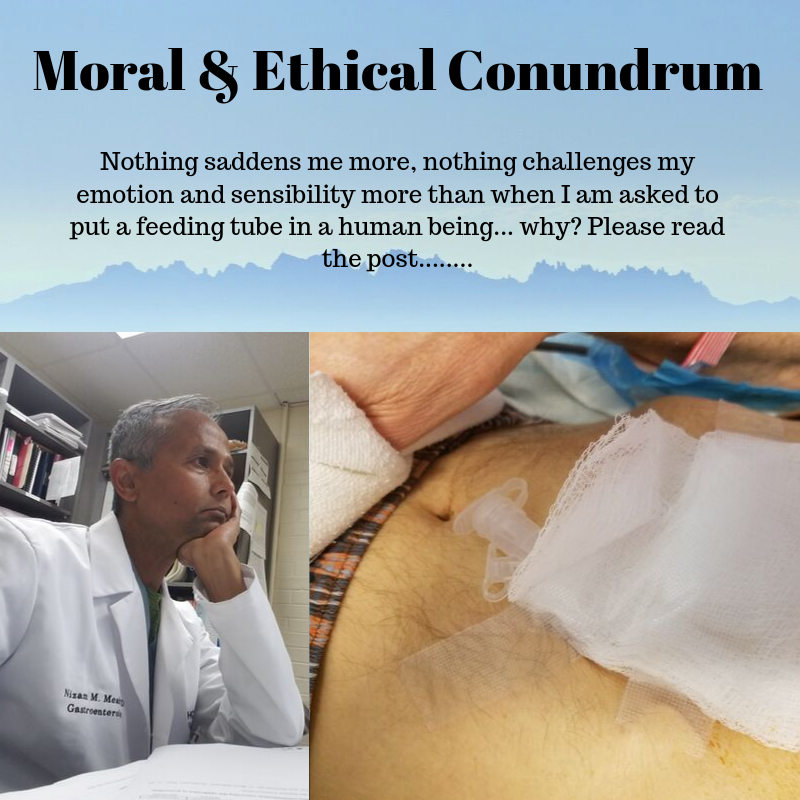
Nothing pains me as much or nothing burdens me as much except when I am faced with the decision of putting a FEEDING TUBE device in a human being. One might question: as a gastroenterologist I am trained to do this, I have done lots of them and also it is not that the procedure is particularly more dangerous than any others that I do. Yes, technically speaking it is easy for me, I have not found it more dangerous than many other things that I do in my day to day practice. Yet, at a human level I find it to be extremely difficult. People who need feeding tube often have lost control over their lives either by stroke, Alzheimer’s, cancer, accidents or other major life-changing events. Lot of them cannot even communicate, living in a state of either in coma or in persistent vegetative state. People who are lucky in such circumstances, relatively speaking, have family members available, in others it might be an administrative decision and even at times a court order. It reminds me of the very basic helplessness and vulnerability that we have as humans. Perhaps my own subconscious does not like that reminder in such a vivid way. Then again, how do I know I am making the right decision to put the tube in or even in declining in doing so? I know the consequences of not feeding: slow agonizing death, slow dehydration, malnutrition, slow shut down of the vital organs one by one. I also know if I put the feeding tube in, true we have a way of administering medicine and food, but still it may do nothing with relation to the original condition that led to such a situation. Some might say, such a human would still not live the full potential of life. Yet, who am I to make a decision about what quality of life another human should have? In times like this I feel the full burden of human limitations, imperfections and lack of prescience.  But I know that paralysis is not the answer either. I have to make a decision as a physician based on my past and present knowledge and to the best of my judgment, or, using the language of law, “using reasonable medical judgment”. Again, not all cases are so difficult. In some cases, perhaps a family or a friend would tell me a little story about such a person that sheds light to her choices of life, what she wanted, what he or she liked and disliked in the past. Sometimes, patient will leave a letter or a will clearly delineating what she would want. Easiest one will be the one who has a loving family member and who can relate to the disabled personal at a very emotional level. At times I will have supportive kin or caregiver. At times I just have to make the decision summoning all my inner strengths. At times even in the midst of such tragic cases, there are happy endings, not all are gloom and doom. So let me finish my current story with such a fairy tale but true story: just last week, such a human patient was brought to my office from nursing home accompanied by his brother. In my office, the human patient was in wheel chair, not making any eye contact, he had words but not purposeful and neither making any sense to a human with limited perception like me, a doctor. The nursing home staff and brother told me that he has been living in nursing home after the major heart attack he had about a decade ago and went to cardiogenic shock. Although he was revived, due to lack of oxygen, his brain suffered irreversible damage and he was not able to freely move or take care of his daily needs anymore. Since that time he has been living in nursing home and doing reasonably well. He seemed to get across his brother very well and each week, the brothers will go out and eat and watch a movie together. Sometimes after the matinee show, the two brothers will go for a wheel chair stroll on the nearby shores of Gulf of Mexico and Galveston Bay. At the end his brother will drop him off. For last three months, he developed difficulty of swallowing food. He seemed to be hungry but just not being able to eat. Nursing home and brother wanted to give him some times thinking it could be a temporary situation, but his condition went downhill without any reversal leading to more weakness and severe weight loss. I could do no meaningful communication with the patient himself and on my physical examination he had all the telltale signs of recent weight loss, dehydration and malnutrition. I found no contra-indication of placing the feeding tube.  Technically and medically speaking, he was an appropriate candidate for Percutaneous Gastrostomy Tube or stomach feeding tube placement. At this time only issue to reconcile with the ethical and human issues associated with the medical procedure. In another word to put myself in the shoes of the patient and sort out if the patient would have really wanted it or not or is it in the best interest of the patient. I wanted to gain more insight into the patient, his past and present. I started speaking with the brother, the only line of communication I had with the patient. He reminisced from the childhood memories of their growing up together in the expansive geography of West Texas. The two brothers grew up in a farm, with nearest neighbor eighteen miles away. They spent times in fishing, hunting and also getting into mischief. In such a desolate land, the two brothers were best friends. When his brother, our patient, had the heart attack and subsequently became disabled, the other brother brought him back from West Texas to South Texas, a distance of 10 hours of driving and settled him in nearby

Am I Wrong or Am I Right? Read More »

The Boy Who Stole His Mom’s Money

The school house was high up on a flattened mountain top clearing of Chittagong Hill Tracts, a district in the farthest corner of Indian subcontinent and called appropriately so due to its hilly terrain and forbidding landscape of impenetrable jungle infested with year-round malaria and dengue causing mosquitoes. Its open spaces were carpeted with tall shimmering green grasses undulating languidly like a ballet dancer with the passing of humid breeze where blood sucking leeches lurked on every blade. Although surrounded by lush green rain forest, in the dog days of summer, the tormenting brew of high humidity, heat of the tropics and bright sunshine used to raise the temperature to 110 to 120 degrees Fahrenheit in the tiny tin roofed school building where four class rooms for nine to ten year old school children were housed. Currently on lease from the government of Pakistan by a giant private paper company that exploited the natural resources of the surrounding forest to make paper, no one actually knew how this building came into being. But elders say it was an abandoned hill-top Second World War era military station which in its hay days served as surveillance outpost in the Anglo-Japanese war front when the Japanese Imperial Army occupied Burma rather quickly and was knocking at Chittagong, located in the farthest South Eastern corner of British India. The building was in disrepair and dilapidated; passage of time was evident on some of its corrugated tin sheets that had curled up and rusted long ago; in some others, rusting had given way to small holes through which sunlight poured in the midday like a thin slicing sword down from the heaven.  The building base was a square of cement slab with brick walls on all sides; the cement was peeling away in many areas exposing the carnelian red bricks in places. Each of the classrooms could perhaps accommodate twenty children at the most, but now due to rapid population boom of this jungle town, fifty to sixty children were crammed in the same tiny space. Only some of the students could sit on the stools with a desk and the rest either stood on foot or sat on the floor during the class time. Children used to come on foot traversing the dusty winding road cut in between the mountains from dense settlements sprawled at the foot hills of the hilly tracts, from far and near. Then they had to climb hundreds of steps of thin stairways, curved on the steep side of the mountain to get to the class room. This was the most dangerous part of their journey to school everyday and children did it with remarkable patience and care, because they knew just one slip of stairs meant their young body will swirl down several hundred feet down below. Climbing the steep stairs by the time they had reached the top of the hill, they were already drenched in sweat. The class rooms had no running water, but there was piped water that ran near the outhouse little further away. The water was pumped through the exposed on-the-surface metal pipes, and it was as hot as boiling water in the summer. Being so hot both inside and outside the class room, the children needed a constant supply of cool water. The school had no air conditioning and in those days, children in the remote corner of East Pakistan, current Bangladesh, had never heard of refrigerator yet, let alone having one in the class room to keep the water cool. The only way they could keep the water cool is by storing water in an earthen pitcher, locally called “kolshi”. This large earthen vessel of the size of a giant turkey fryer used to be kept on the corner of the class room and students and teachers alike could pour in a little drink of cool water in their ceramic glass they all shared to keep them hydrated especially in the long hot summer days. Earthen pitcher cools down water by capillary action, a basic law of physics. One day early in the summer time the old earthen pitcher of the class broke into pieces as it grew old and could not contain the pressure of the water inside it any longer. Children had no more supply of cold water, and in their tender mind, they knew that it was essential for their life. They decided to raise money and buy a new kolshi soon. Although just few pennies in American currency, it was expensive for the children in this corner of the world, where some of them used to come to school without any breakfast and some of them could only afford to eat one meager meal a day. So raising money was difficult and yet they all pitched in with an urgency and they raised about five “takas”, equivalent of six US pennies. A boy, son of a teacher, who was voted as the “Class Captain,” was given the responsibility to safe guard the money the class had raised and it was his job to buy a new kolshi from the bazaar, one hour on foot journey from the neighborhood.  The class decided for him to accomplish this on the weekend so they have cool water from next Monday. As the Sunday came, he was ready to go to the market with the raised money to buy the kolshi. He took out the only pair of pants he had, which he always wore to school and as he put his hand in the pocket, he felt no coin! He was surprised; a shiver crossed through his spine. He put his hands on both the side pockets and then to the back pocket, but his fingers felt no money, no jingle of coins. He was at a loss and he now started sweating profusely. What had happened to the money? Did he lose it or did some one play a trick on him or had someone picked his pocket? What should

The Boy Who Stole His Mom’s Money Read More »

Prognosis: Excellent

She is a 53 year old female. I am a 55 year old gastroenterologist. I was consulted because she had suspicious tumors in her liver on a CAT scan. She has been feeling increasing distress in her upper belly and has not been able to keep anything down in her stomach for last two weeks. The pain was not the severe pain that curls you up, but it is gnawing, that eats you from inside, it is the pesty visitor who visits you at the most uninviting of the moments, it is the conversation that one has to carry on in the most importunate of the situations. I reviewed her labs and scans carefully before I enter her room. I take a pause and a deep breath and tell myself: “Hey you, cheer up, have a smile on face, and make sure your patient does not see you gloomy or anxious”.  Having obeyed my own advice, I apply several soft knocks on the door. “Come in” I hear from outside and I enter the room. Laying flat on the bed was a thin lady, ashen looking, covered in white freshly cleaned hospital blanket and the protuberant abdomen sticking out like a sore thumb from under the sheet betrayed her frail physique. Next to her sitting on the rocking chair was her male companion wearing a red bandanna on his head; his white long unkempt beard and cigarette stained handle bar mustache giving out an impression that he would be better fit to the next Duck Dynasty episode casted outdoors in the midst of nature than belonging to this claustrophobic beige colored hospital room with its fours walls closing in on the small space all the times. I have always found hospital rooms to be very interesting. Some rooms seems to be bright, others dim and dark although when I counted they exactly have the same number of flood light fitted on the ceiling and on the sidewalls. The healthcare architects are great in consistency and meticulous in attention. Master of their trade, from faucet to air conditioning vent to a small emergency switches, all of them in exactly placed in the right position, they have an uncanny skill and attention to details, nothing seems to distract them, nothing seems to make them forget even the smallest of the things in pursuit of their job of designing and planning a hospital. I never had much luck in picking their fault as far as hospital patient rooms are concerned. When I cannot explain by science, I always resort to my inner superstition: I concocted the same about the hospital rooms, since architecturally and physically they are all the same and immaculate. I came to believe, the rooms that are bright, or at least appears to be so in my eyes, patients tend to do well and the rooms that are dim and melancholic, they take their occupants into the abyss of dooms. Sometimes I wonder how the admission clerk assigns the room to the patients, is it first come first serve? Or is it at her whims? Or may be she has no choice, the computer assigns it randomly like many things now a days. In my own obsessed physician’s moments, when I get carried away with my own physical symptoms and there are times when I felt calling the EMS to take me to the hospital, not as a doctor, but as a patient. Then in my mind, like an well orchestrated Broadway drama, I go through the rehearsal: As soon as the EMS takes me to the hospital I ask the admission clerk, “I want room number……..” She will be surprised and I will look at her with authority and make sure I have the stethoscope on my shoulder, or my physician ID still displayed somewhere visible and insist, “You have heard what room number I wanted Ma’am!”. Then she might say, “But Dr. Meah, that room is taken, there is already a patient in there!” . Well, my imaginary Admission Clerk certainly got me, after all I cannot ask her to expel the existing patient, I am only a doctor, not a savvy apparatchik national figure who can order around. That’s when I feel like I should develop a secret list of good and bad rooms in the hospital, my own top secret, I will share with no one, although unethical, its use is my nuclear option, only to be used when my own life is at stake, and I come to this hospital and I will tell them give me this room number…..! “Taken”, she will answer,  “No problem, give me number……” I will say keeping my smile hidden.  “Taken”, she might say again.  “No problem, then give me number…..” as I pull out another room number from my secret private list, I know something has to work out, US hospitals have always rooms empty since most of them are made to an excess capacity.  Thus I have thought about making a secret inventory of hospital rooms, that is good and bad rooms, although, my laziness had not yet come around doing this in actuality. I introduced myself, interviewed her and after obtaining her consent, examined her confirming all the ominous signs that in medical literature we summarize as, “Stigmata of chronic liver disease” with “signs of hepatic decompensation”. She had a large liver, double the size of normal; it was filled with many marble sized tumors and beneath her wasted skin, these felt as firm as the glass marbles that I used to hide away from my younger brother underneath a cotton blanket in my distant childhood.  Normal liver feels slippery, soft, gentle and soothing to palpating finger tips of the examiner, unlike these bold and hard knots, there was something aggressive about them. I noticed her feet were swelling too and one area on the right shin had started oozing clear fluid, a sign that her liver was not able to make enough protein to keep her own fluid inside the body. Her chest was full of dreaded “spider

Prognosis: Excellent Read More »

My Patient’s Story Is My Story

I am a healthcare professional, I treat sick patients everyday, death is not uncommon in the practice of my trade. How do I mourn the death of such a dear friend and a mentor? With great sadness, humility, gratefulness and lots of treasured memories. My dear friend, our dear friend Mr. Donald Correll recently passed away. But my memory still so vivid and alive. I was one of his doctors, I have seen him numerous times and I have enjoyed every time seeing him. He is the kind of patient who becomes a friend and mentor. His story, my patient’s story is my story after all. I still remember: the year was 1995, month was September. A surgeon in the hospital I was working had consulted me on his case. I was then a young medical graduate, a medical cowboy, fresh from GI Fellowship, on the first week of practice determined to make it out all alone in Texas. The surgeon who was rather perplexed wanted my help in managing him: Mr. Donald Correll was in excruciating pain. With his permission I sat down by his bed side, I listened to his story and without ordering any other investigation, I diagnosed and started treating him. The next day in round, he was already walking on the hospital hallway and a broad smiling face greeted me: “You saved my life!” he said, holding on the thin stainless steel shaft of the IV pole, his face alight with the aura of generosity and gratitude as big as Texas. My heart was filled, filled with joy, confidence and gratitude! I had started a brand new practice: it was a tremendous leap of faith, no one was there to watch over my shoulders. Born and raised in Bangladesh, I loved America since my intelligence developed and am a total sucker of American Free Enterprise System. I headed to  the  hinterlands of Texas all alone with this belief, leaving all my support system at the University Medical Center turning down offer of being a faculty member and other jobs. This was a time of exhilaration, this was a time of fear and apprehension, it was a time of vast potential or total doom. I needed reconfirmation, I needed people to believe in me, I needed people to say: Yes you can. I needed to prove to myself if not anyone else. And Mr. Correll was just the person! I am so grateful, so humbled. People like him and others made me successful, they allowed me to deliver my promise to myself that I would be by the side of common people out in the community, my story will be their story, their story will be mine, my care will be bare, down to humanity, no frills attached. It is the spirit and good will of people like Donald who come to me as patients and friends that enriches the blood flowing in my veins, this is why I went to med school, this is why I spent my time in research and advanced training, this is the direction and lesson my parents had taught me, this is the religion I follow. Donald, a Texas rancher, later became my teacher: teaching me about land, cattle and farming and how to care for them. He is a great teacher. Today, he may not be with us among the mortals, but he is with us in spirit, and in friendship, these never die. So, my friend Donald, prayer comes from heart, it is a mutual feeling of heavenly experience. I will miss you, but you will never be forgotten. Your legacy lives on, you do not know what you have done for me.

My Patient’s Story Is My Story Read More »

Inner Orchestra

Your whole life you have lived healthy. You have eaten healthy and patronized good habits. Your good health and sense of good well being therefore, is not an accident, rather the result of your diligence and calculated choices of life. You are active, fully functional and enjoy the finer things in life, friends and family. Then comes the sudden betrayal of life. You have the urge; you have the sense of immediacy that you always depended on. Except you sit, first for few minutes thinking just taking time would help, then fifteen minutes goes by and then thirty minutes! You strain, perhaps by now with some feeling of nausea, you have looked at the favorite magazine flipping through all of its pages, or surveyed all the pages of the old newspaper that had been left in restroom in forgotten past, you had re-examined every component of the potpourri you had stacked away on the vanity table of the rest room, you even had the second and the third look at the little painting of the flower you had hung on the wall of your intimate restroom only now discovering the little imperfections all the while sitting patiently on the commode sit.  But it won’t come. Not that it doesn’t want to come out, but you have the feeling that something is blocking it, something is not letting it out in the open. Your colon betrays your wish, your body’s wish, defying the signals of your brain and the spinal cord. You come out of the experience frustrated, sweaty, and fearful; but hope for the best and hope that it would solve itself next time around. You redouble your good diet, increasing fiber, and then you visit your neighborhood’s friendly pharmacy buying some remedies, a probiotic perhaps in addition to laxaitives. But next day is the same and more of the same is the following day. You wonder what’s happening and why is it you? The very thought not only makes you scared but even angry. You have all the terrible thoughts: “Do I have colon cancer?” “What did I do wrong” or “Perhaps I am not still eating right”! You second guess, begin to doubt yourself and your mind goes crazy. This is exactly what happened to my patient Mrs. X. She grew up in Boston. Following New English Irish tradition her early education was completed in Catholic Schools. She grew up in a single parent home and lived in government housing for a time. Those are the days in Boston’s Catholic bastion, children of single matriarchal family were frowned upon, not that anyone told anything openly, but the unexpressed “there’s something wrong with your family or mother” was evident in their expression and refined New England accent. When I saw her in the office her complaint was constipation. But not the “normal” constipation that people suffer from! It is the constipation that has urgency of bowel movement but as if her colon is betraying her by not relaxing, an act that is essential for a successful and satisfying bowel movement. In her interview, I could realize right away that she was a born artist; she was born to sing as she claims. Her sentences with New England accent were rich in inflections, her eyebrows and facial muscles danced together like a performing singer on a stage. Her face bore the aura of a Prima Donna, her lips and eyes moved in an inner drama of conflict reminiscent of Tchaikovsky’s Tatiana. In her adult life she had moved from bustling metropolis of Boston to an obscure Texas town in the somnolent shores of the Gulf of Mexico never singing, never been in stage and thus never fulfilling her dream. I know her for years. She considers herself a failed artist. Her heart wanted to be an artist and mind wanted to sing. But realities of life had never fulfilled her dream. Instead, her heart and mind became the ground of an internecine warfare, a war that is eternal, and a war that has no ceasefire. Quite a few years ago, she visited my office for the first time with a nagging pain on the right upper side of her abdomen, which was worse with eating and at times radiating to the upper back. Extensive investigations including CT scans and MRIs showed a swollen bile duct, but no stone in the gallbladder or no tumor or cancer in liver or pancreas. I finally diagnosed her to be having dysfunction of her bile duct sphincter or guarding valve of the bile duct, known medically as Sphincter of Oddi dysfunction. In this condition the valve of the bile duct fails to open or relax in response to a meal when our food content reaches the upper part of small intestine. Bile carries important enzymes for digestion of fat and protein, so the action had to be very rhythmic, precise and timely, like that of a well functioning orchestra. It is a fine sophisticated action, accomplished by interaction of nerve signals, hormone signals and the influence of the food itself. To give her a relief, I treated her by cutting the valve of bile duct medically known as ERCP with Sphincterotomy which resolved the problem. Few years had gone by and she again presented to me with the problem of intractable constipation. Upon careful history taking she was the example of good life and good habits. Her physical examination was naturally quite normal. She is the picture of health, externally. Having ruled out any other new problem by ultrasound and having ruled out Colon cancer by Colonoscopy, my diagnosis was Pelvic dyssynergia. This is another condition where the complex coordination of our brain, spinal cord and action of muscles of colon, rectum and pelvis fails. This results in failure of relaxation of the muscles and therefore the feces or stool cannot come out. Human colon is a tube made up of specialized muscles and with a length of four to six feet, it is easily the second

Inner Orchestra Read More »

Medical Detective: Anemia, Dr. Denton Cooley Busted!

Medical detective: Anemia, Dr. Denton Cooley Busted! It’s real, just listen to the story: Don is 85 year old man, who visited me for finding out the reason for Iron Deficiency Anemia. Anemia means low blood, Anemia is not one disease but many diseases. His specific type was Iron Deficiency Anemia, meaning that he is chronically losing iron from his blood. This means he had to have a mystery bleeding somewhere internally in his body, most common being in the GI or Gastrointestinal Tract. He had had this anemia for a good while and his primary care physicians had tried with iron as a band aid but he continued to be anemic and that is why he was sent to me so we could unmask his hidden bleeding. The cause could be hidden anywhere  in this GI tract, from stomach to small intestine to colon and each of these being vast organs, the story could be complicated and challenging. It could be from Peptic ulcer in the stomach to small bleeding vessels deep in the crevices of small intestine which is a twenty two feet long organ to colon cancer Don was born and brought up in Texas. Don had a serene look in his face, he is a man who is lean and thin still muscular even in this age, his dressing was clean cut, face was clean shaved and his gait had no hint of hesitancy totally unburdened by age.

Medical Detective: Anemia, Dr. Denton Cooley Busted! Read More »

my mother

An Orphan’s Mother’s Day

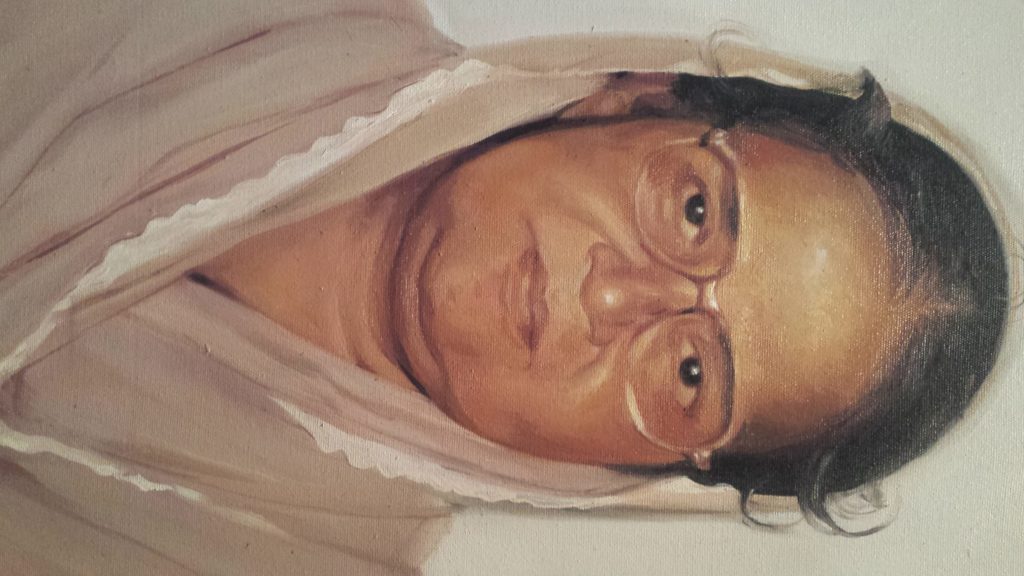
An Orphan’s Mother’s Day, that is my Mother’s Day with my mother is silent, somnolent, serene and solemn. I never take her out to dinner, not even to lunch. Bouquet of fresh flower? Even that’s out of question! May be a physician son like me would like to buy something expensive, something exotic for my mother! Well dead wrong again! Then what do I do for my mother on a Mother’s Day? Nothing, and nothing, and yes, nothing. Plain and simple. Paraphrasing Mark Twain, there are only two kinds of people in the world: the ones who have mother and the ones who don’t, I mean a mother who is living in flesh and blood. I belong to the latter kind. We are Orphans. For us, Mother’s Day is not a celebration in traditional means, for us it is a mixed emotion; a strange state of mind where celebration and mourning happen together. Have you ever known people without mother or people who lost their mother early in life? If you didn’t yet or if you had not have the occasion of conversation with one of them on this then let me let you know that we walk, talk, laugh and live our life with a strange subconscious burden every day,  but as the Mother’s Day rolls around, that burden becomes heavier, more conscious, more real. I know exactly when the Mother’s Day is coming: the UPS guy in the neighborhood gets busier delivering packages form Amazon, malls and restaurants are busier; when I open my browser, blinding colorful Pop Ups announce: Send Your Mother Something Memorable; beautifully animated flashy announcement from 1-800-Flowers: Send Your Mother Flowers, let her know you love her. Oh! Yes, let your mother know you love her. My mother is far beyond this flower or dinner business, beyond the reaches of UPS or FedEx, beyond the blinding internet Pop-Ups. I still remember the day: it was a sunny Midwestern day in Detroit, September 17th, 1989 to be exact. I was in first year of my internship; this was post–call day for me. Although tired, sleeping is not for me, I ate breakfast and showered and got on new pair of hospital scrubs, which were my usual 24 hour attires at that time, and I was trying to get some studies done in internal medicine. A friend called and wanted to visit, I sensed something wrong, but kept the feeling inside and welcomed him with his wife. “How’s the family back at home?” they asked, “Fine, okay I think”,  I answered, investigating their facial reaction and knowing subconsciously that it was not the real question or answer they were interested in.  “How’s your mom?” the friend’s wife asked as her second sentence. “She’s always weak, she works so hard…..” my heart stopped for a moment as I caught myself talking and my words dropped off, “Wait a second are you saying that something is wrong with my mother? Are you saying that? Are you saying that? “, I became frantic and couldn’t help screaming. I just picked up the phone right in the living room, in a reflexive response and started dialing the phone line.  1989! This was not yet the time of cell phone and internet! Back in the old country, the town of Chittagong, 8000 miles away from Detroit, Michigan, my family did not even have a phone, I mean land phone. If you could bribe the government owned telephone monopoly, you could get one in 10 years and if you didn’t have the money or means to bribe, the wait could be forever. So I used to dial a neighbor’s house and they were always gracious to call my family to talk to me and this used to be the way to communicate. As I kept on frantically dialing, the only message I got from AT&T was, “All international lines are busy in the country you are dialing, please call later”. I frantically called the AT&T operator, call could not go through even with her help; no one could help. This was the state of communication in those days in the poor 3rd world countries. Even emergencies had to wait! I did the only thing I could do, sob and kept on trying, finally reaching one time after five hours of trial! Just think about it: getting phone line after five hours of continuous dialing. Strangely, in the worst of grief and loneliness, the human benevolence takes over: I only wanted to know how my mother died, what she said as her last words and my main worry was my family, especially my younger siblings, how helpless they were feeling without a mother, how they will be taken care of. I totally forgot of myself. By the time I could make arrangement calling the med school and airplane ticketing and other formalities, and then finally reached the old hometown after 3 days of grueling journey, my mother’s body was only represented by a freshly turned pile of red dirt lying in her ancestral graveyard on a hilltop next to a 16th century mosque that was founded by a revered Saint of Chittagong, my ancestral home town.  There is always a strange silence in the graveyards, even in an overpopulated country. After the eight thousand miles journey that was my first stop over, I fell on my knees, I cried but my eyes were dry from the dehydration of three days of journey over the oceans, mountain ranges and continents. As I prayed, I felt my mother would come alive at any moment, a strange, lunatic sense of denial conquered me over, I prayed and prayed but the miracle never happened, my  mother never rose up, she never talked to me, I never saw her in flesh and blood, never again. Who knew that two years ago on my way to the United States, when I said goodbye to my mother in the dusty Second World War era airport of Chittagong that was going to

An Orphan’s Mother’s Day Read More »