Uncategorized

Am I Wrong or Am I Right?

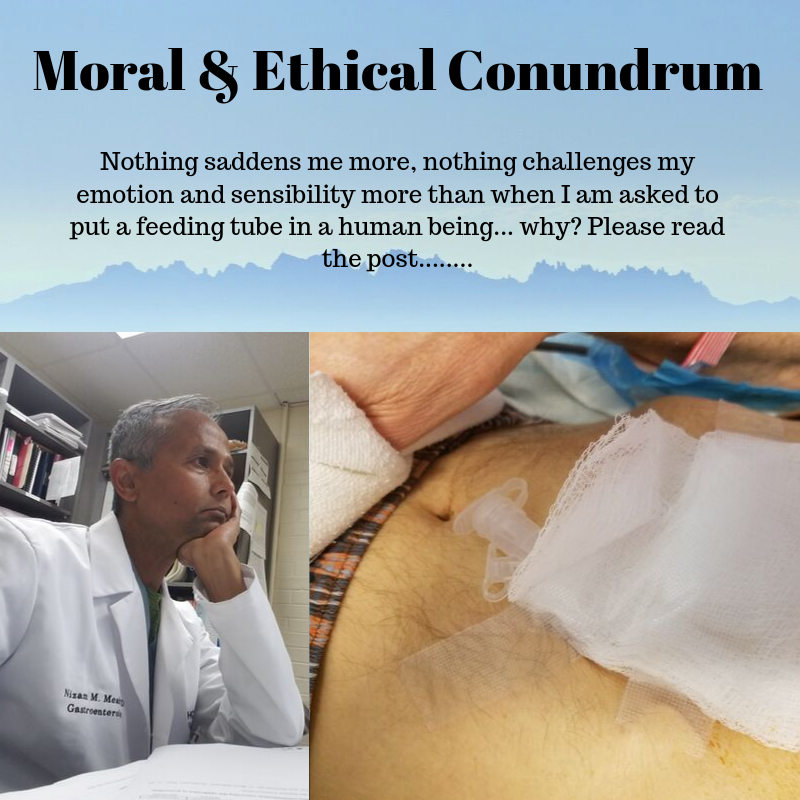
Nothing pains me as much or nothing burdens me as much except when I am faced with the decision of putting a FEEDING TUBE device in a human being. One might question: as a gastroenterologist I am trained to do this, I have done lots of them and also it is not that the procedure is particularly more dangerous than any others that I do. Yes, technically speaking it is easy for me, I have not found it more dangerous than many other things that I do in my day to day practice. Yet, at a human level I find it to be extremely difficult. People who need feeding tube often have lost control over their lives either by stroke, Alzheimer’s, cancer, accidents or other major life-changing events. Lot of them cannot even communicate, living in a state of either in coma or in persistent vegetative state. People who are lucky in such circumstances, relatively speaking, have family members available, in others it might be an administrative decision and even at times a court order. It reminds me of the very basic helplessness and vulnerability that we have as humans. Perhaps my own subconscious does not like that reminder in such a vivid way. Then again, how do I know I am making the right decision to put the tube in or even in declining in doing so? I know the consequences of not feeding: slow agonizing death, slow dehydration, malnutrition, slow shut down of the vital organs one by one. I also know if I put the feeding tube in, true we have a way of administering medicine and food, but still it may do nothing with relation to the original condition that led to such a situation. Some might say, such a human would still not live the full potential of life. Yet, who am I to make a decision about what quality of life another human should have? In times like this I feel the full burden of human limitations, imperfections and lack of prescience.  But I know that paralysis is not the answer either. I have to make a decision as a physician based on my past and present knowledge and to the best of my judgment, or, using the language of law, “using reasonable medical judgment”. Again, not all cases are so difficult. In some cases, perhaps a family or a friend would tell me a little story about such a person that sheds light to her choices of life, what she wanted, what he or she liked and disliked in the past. Sometimes, patient will leave a letter or a will clearly delineating what she would want. Easiest one will be the one who has a loving family member and who can relate to the disabled personal at a very emotional level. At times I will have supportive kin or caregiver. At times I just have to make the decision summoning all my inner strengths. At times even in the midst of such tragic cases, there are happy endings, not all are gloom and doom. So let me finish my current story with such a fairy tale but true story: just last week, such a human patient was brought to my office from nursing home accompanied by his brother. In my office, the human patient was in wheel chair, not making any eye contact, he had words but not purposeful and neither making any sense to a human with limited perception like me, a doctor. The nursing home staff and brother told me that he has been living in nursing home after the major heart attack he had about a decade ago and went to cardiogenic shock. Although he was revived, due to lack of oxygen, his brain suffered irreversible damage and he was not able to freely move or take care of his daily needs anymore. Since that time he has been living in nursing home and doing reasonably well. He seemed to get across his brother very well and each week, the brothers will go out and eat and watch a movie together. Sometimes after the matinee show, the two brothers will go for a wheel chair stroll on the nearby shores of Gulf of Mexico and Galveston Bay. At the end his brother will drop him off. For last three months, he developed difficulty of swallowing food. He seemed to be hungry but just not being able to eat. Nursing home and brother wanted to give him some times thinking it could be a temporary situation, but his condition went downhill without any reversal leading to more weakness and severe weight loss. I could do no meaningful communication with the patient himself and on my physical examination he had all the telltale signs of recent weight loss, dehydration and malnutrition. I found no contra-indication of placing the feeding tube.  Technically and medically speaking, he was an appropriate candidate for Percutaneous Gastrostomy Tube or stomach feeding tube placement. At this time only issue to reconcile with the ethical and human issues associated with the medical procedure. In another word to put myself in the shoes of the patient and sort out if the patient would have really wanted it or not or is it in the best interest of the patient. I wanted to gain more insight into the patient, his past and present. I started speaking with the brother, the only line of communication I had with the patient. He reminisced from the childhood memories of their growing up together in the expansive geography of West Texas. The two brothers grew up in a farm, with nearest neighbor eighteen miles away. They spent times in fishing, hunting and also getting into mischief. In such a desolate land, the two brothers were best friends. When his brother, our patient, had the heart attack and subsequently became disabled, the other brother brought him back from West Texas to South Texas, a distance of 10 hours of driving and settled him in nearby

Am I Wrong or Am I Right? Read More »
Complications of Medical Procedures – use it to build a Human Relationship

Practice of medicine or healing is an invasion of human body by definition. Even a medication that can save life of someone has the potential to kill someone else, inadvertently. Every “minimally” invasive surgery procedure to major surgery has the potential of harming a patient either by omission or by commission. Adverse affects, complications of treatment and surgical procedures are common, according to Institute of Medicine in 1999, 44,000 to 98,000 deaths occurred due to medical errors and according to other estimates, 400,000 deaths a year could be attributed to this. Worldwide medical adverse event could be 43 million! In the survey of Kaldjian et al, 93 percent of physicians indicated they would disclose medical errors to their patients which is in sharp contradiction to the finding of the same authors that in practice, only 5 percent did so. The very minting process of the physicians is with Hippocratic Oath, “Do no HARM” which rings in such a contradiction to them causing harm or complication, whether by omission or commission. A physician’s natural reflex in such an event is denial: trying to find a distance to suppress the anxiety, culpability, fallibility, shame and crisis of confidence, all being the results of normal human emotions. Since complications are inevitable and even the most skilled of the physicians will have complications in the normal course of their practice life and since complications could be unpredictable in many cases, how should they handle it? A study by Ragenbogen on colorectal surgeons found that complications do change the relationship of patients and surgeons, however, trust remained high among surgeons who had better communication skill. In my own practice I have found that honesty, humility and treating the patient as a peer human is the best way to deal with the aftermaths of complications. In fact, I turned the communication part upside down by being proactive. Whenever a complication happens or there is a risk of complication as in a “high risk” patient or high risk procedure, I personally call the patient, take the responsibility and explain the rationale to the best of my knowledge and explain them what to be anticipated and how long they are expected in the hospital if they are hospitalized. I find that in many cases, by paying attention, I can identify “high risk patients” in advance, an example will be a patient undergoing colonoscopy who is on blood thinner for heart condition, or a patient who has many pre-existing medical conditions who needs to undergo a procedure. In these cases, I inform and educate the patient and family in advance as to what could be anticipated in the aftermath and should it ever happen what to do first and then give me a call. In my own case, after taking this approach, I have been able to form a solid bond and even friendship with my patients who had complications or are at risk of complication. The anticipation part and the advanced education part really help and when and if something occurs, let alone losing trust, patients increase their trust on the physician. In my case, some of my such patients have gone on to become my well wishers and great friends. Some became my teachers and mentors, teaching me other skills of life like ranching, engine repair and animal husbandry. This approach has given me lot more comfort and confidence in my practice. Most of all, it has enriched me as a fallible human, giving me a satisfaction and meaning of life. Thus, I have turned the fear of medical complication upside down and made it into my friend acknowledging my humility and limited knowledge.

Complications of Medical Procedures – use it to build a Human Relationship Read More »

Prescription for Doctors, from Patient

“Look at the patient, to listen to the patient, and not be so hastened to write out that prescription and get them out the door”.  This was the starting commentary of a long term patient of mine whom I was interviewing recently. She is an intelligent and articulate person and can express herself very well and this is why I always loved and respected her as a person and as patient. In our many years of relationship I have been with her in the ups and downs her life and so as her families’. Several of her family members are also my patient. So, when I requested her this interview, she easily agreed with a smile and a confident composure. Although I told her that the story could be about anything that had impacted her life, she decided that her story should be about doctors and office visits since it had great impact in her and in her family’s life. It was not until the end of the story that I realized this was a great Prescription for Doctors, from Patient. She went on saying, “Patients like in my case could have more than one issue when I visit a doctor’s office, so which one do we need to talk first this time? In my case I write down a list because I forget often and then I talk one by one and my Primary Care Physician who has the patience of listening through it. I get so aggravated that I have to wait so long just to see him, but its worth it because when I am seeing him, he spends the time, just like you do. I am not just a number, I am not a money-pocket, not just the insurance, it is me, you are concerned about me. That’s important. Sometimes I wait for hours because once I get to see him (my primary care doc) he makes me feel like I am the only patient!” I know her sister and brother in law, two years ago the brother in law was diagnosed to have pancreatic cancer by me. He is still living as of the date of this interview but he is on his way down. When she went to his topic, she started crying and sobbing, and then her gaze deepened at me, “It started with you, it started with you caring, being sensitive to him as well as to my sister, I appreciate that, the family comes to you more, because you are tenderhearted and you showed that you care, I have faith in you totally, I know when you say I have an ulcer or a polyp, I know that you gonna fix it, it is as simple as it.” as she stated. I was filled with a great grief about her brother in law as well as a tremendous happiness as a physician to hear this from her. She went on saying, “My wish for myself is that people will see God in me, that I lived, I walked and I talked with God in me. I stopped smoking about a month ago, I smoked a pack and half a day for over four decades,  because both you and Dr. PCP (Primary Care Physician) was getting on by behind hiney..I did cold turkey! For you physicians, Listen, just listen, don’t say wow, I can get her insurance,insurance will pay, its not a money thing, it shouldn’t be, it should not be cattle running through a track for slaughterhouse. It should be truly one to one. When patients and physicians start taking each other seriously, then people will get more healed, not to get God out of the picture. Listen physicians, you guys are very smart, God had given you the wisdom to learn, he put you on this earth for a reason, that is to help us, that is your purpose on earth. by doing this means is to listen to us whole-hardheartedly to figure out what’s wrong with us.” Then I asked her about Life changing event in her life and this is what she told me,  “A year and half ago my grandson was born. He was born with a collapsed lung and lung deformity. He was in local Children’s Hospital for two and a half months. He was on a heart-lung machine, and on an artificial kidney machine. they told us he would probably not live through the first surgery, they told us he will live “one hour by one hour”.  We all put our faith in God and our trust in the doctors, they were always there, they would give us the worst scenario and the best scenario. they always said, “he could live one more hour, one more hour”! And today he celebrates his first birthday! I am so moved, he is a blessing, just like my brother in law. I have learnt from it to put my trust and faith in God, and to treat people the way you want to be treated. Be kind, be generous, don’t be having negativity, even in the most difficult of circumstances. Like even when my grandson was in the most critical moment, they told us “There’s a chance!”. And he did have a chance, he did make it! And it changed me, made me humble to see the fragility of life.” Then I asked her, “What do you want people to know about you?”  Without much deliberation or pause she went on spontaneously looking at the walls of the exam rooms she went on, “That I smiled all the times, happy and that I had positive attitudes, that I did not walk about being mad about the world, expressing negativity. I am a retired hair dresser, I taught this trade too, I loved it when people came to me and said, “You’re just a great hair dresser, I learnt so much from you!”,  it’s nice, it isn’t for the praise or boasting but it is nice to know

Prescription for Doctors, from Patient Read More »