
cancer

Am I Wrong or Am I Right?

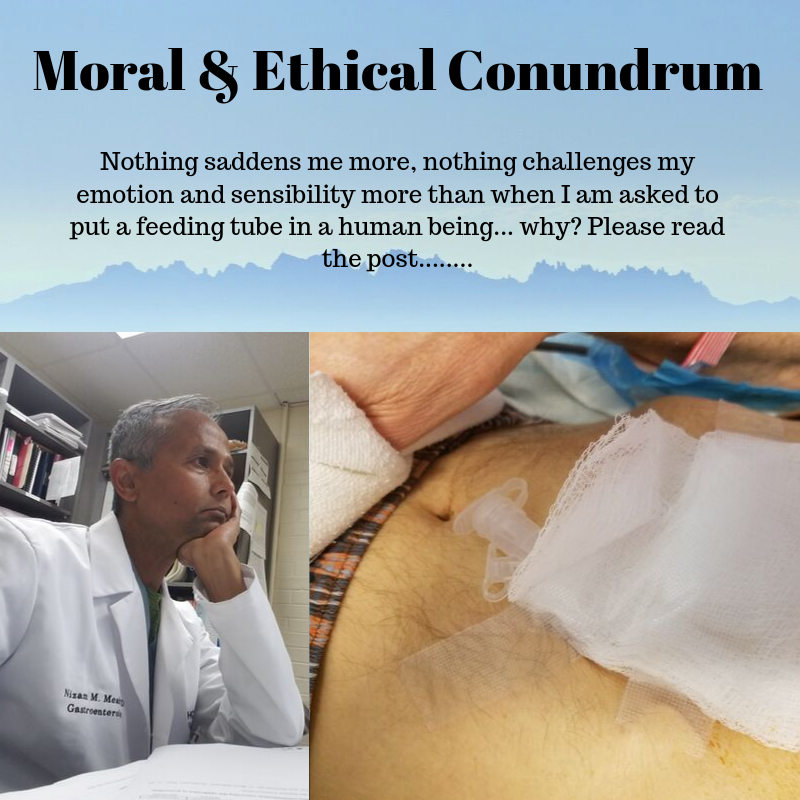
Nothing pains me as much or nothing burdens me as much except when I am faced with the decision of putting a FEEDING TUBE device in a human being. One might question: as a gastroenterologist I am trained to do this, I have done lots of them and also it is not that the procedure is particularly more dangerous than any others that I do. Yes, technically speaking it is easy for me, I have not found it more dangerous than many other things that I do in my day to day practice. Yet, at a human level I find it to be extremely difficult. People who need feeding tube often have lost control over their lives either by stroke, Alzheimer’s, cancer, accidents or other major life-changing events. Lot of them cannot even communicate, living in a state of either in coma or in persistent vegetative state. People who are lucky in such circumstances, relatively speaking, have family members available, in others it might be an administrative decision and even at times a court order. It reminds me of the very basic helplessness and vulnerability that we have as humans. Perhaps my own subconscious does not like that reminder in such a vivid way. Then again, how do I know I am making the right decision to put the tube in or even in declining in doing so? I know the consequences of not feeding: slow agonizing death, slow dehydration, malnutrition, slow shut down of the vital organs one by one. I also know if I put the feeding tube in, true we have a way of administering medicine and food, but still it may do nothing with relation to the original condition that led to such a situation. Some might say, such a human would still not live the full potential of life. Yet, who am I to make a decision about what quality of life another human should have? In times like this I feel the full burden of human limitations, imperfections and lack of prescience.  But I know that paralysis is not the answer either. I have to make a decision as a physician based on my past and present knowledge and to the best of my judgment, or, using the language of law, “using reasonable medical judgment”. Again, not all cases are so difficult. In some cases, perhaps a family or a friend would tell me a little story about such a person that sheds light to her choices of life, what she wanted, what he or she liked and disliked in the past. Sometimes, patient will leave a letter or a will clearly delineating what she would want. Easiest one will be the one who has a loving family member and who can relate to the disabled personal at a very emotional level. At times I will have supportive kin or caregiver. At times I just have to make the decision summoning all my inner strengths. At times even in the midst of such tragic cases, there are happy endings, not all are gloom and doom. So let me finish my current story with such a fairy tale but true story: just last week, such a human patient was brought to my office from nursing home accompanied by his brother. In my office, the human patient was in wheel chair, not making any eye contact, he had words but not purposeful and neither making any sense to a human with limited perception like me, a doctor. The nursing home staff and brother told me that he has been living in nursing home after the major heart attack he had about a decade ago and went to cardiogenic shock. Although he was revived, due to lack of oxygen, his brain suffered irreversible damage and he was not able to freely move or take care of his daily needs anymore. Since that time he has been living in nursing home and doing reasonably well. He seemed to get across his brother very well and each week, the brothers will go out and eat and watch a movie together. Sometimes after the matinee show, the two brothers will go for a wheel chair stroll on the nearby shores of Gulf of Mexico and Galveston Bay. At the end his brother will drop him off. For last three months, he developed difficulty of swallowing food. He seemed to be hungry but just not being able to eat. Nursing home and brother wanted to give him some times thinking it could be a temporary situation, but his condition went downhill without any reversal leading to more weakness and severe weight loss. I could do no meaningful communication with the patient himself and on my physical examination he had all the telltale signs of recent weight loss, dehydration and malnutrition. I found no contra-indication of placing the feeding tube.  Technically and medically speaking, he was an appropriate candidate for Percutaneous Gastrostomy Tube or stomach feeding tube placement. At this time only issue to reconcile with the ethical and human issues associated with the medical procedure. In another word to put myself in the shoes of the patient and sort out if the patient would have really wanted it or not or is it in the best interest of the patient. I wanted to gain more insight into the patient, his past and present. I started speaking with the brother, the only line of communication I had with the patient. He reminisced from the childhood memories of their growing up together in the expansive geography of West Texas. The two brothers grew up in a farm, with nearest neighbor eighteen miles away. They spent times in fishing, hunting and also getting into mischief. In such a desolate land, the two brothers were best friends. When his brother, our patient, had the heart attack and subsequently became disabled, the other brother brought him back from West Texas to South Texas, a distance of 10 hours of driving and settled him in nearby

Am I Wrong or Am I Right? Read More »

Prognosis: Excellent

She is a 53 year old female. I am a 55 year old gastroenterologist. I was consulted because she had suspicious tumors in her liver on a CAT scan. She has been feeling increasing distress in her upper belly and has not been able to keep anything down in her stomach for last two weeks. The pain was not the severe pain that curls you up, but it is gnawing, that eats you from inside, it is the pesty visitor who visits you at the most uninviting of the moments, it is the conversation that one has to carry on in the most importunate of the situations. I reviewed her labs and scans carefully before I enter her room. I take a pause and a deep breath and tell myself: “Hey you, cheer up, have a smile on face, and make sure your patient does not see you gloomy or anxious”.  Having obeyed my own advice, I apply several soft knocks on the door. “Come in” I hear from outside and I enter the room. Laying flat on the bed was a thin lady, ashen looking, covered in white freshly cleaned hospital blanket and the protuberant abdomen sticking out like a sore thumb from under the sheet betrayed her frail physique. Next to her sitting on the rocking chair was her male companion wearing a red bandanna on his head; his white long unkempt beard and cigarette stained handle bar mustache giving out an impression that he would be better fit to the next Duck Dynasty episode casted outdoors in the midst of nature than belonging to this claustrophobic beige colored hospital room with its fours walls closing in on the small space all the times. I have always found hospital rooms to be very interesting. Some rooms seems to be bright, others dim and dark although when I counted they exactly have the same number of flood light fitted on the ceiling and on the sidewalls. The healthcare architects are great in consistency and meticulous in attention. Master of their trade, from faucet to air conditioning vent to a small emergency switches, all of them in exactly placed in the right position, they have an uncanny skill and attention to details, nothing seems to distract them, nothing seems to make them forget even the smallest of the things in pursuit of their job of designing and planning a hospital. I never had much luck in picking their fault as far as hospital patient rooms are concerned. When I cannot explain by science, I always resort to my inner superstition: I concocted the same about the hospital rooms, since architecturally and physically they are all the same and immaculate. I came to believe, the rooms that are bright, or at least appears to be so in my eyes, patients tend to do well and the rooms that are dim and melancholic, they take their occupants into the abyss of dooms. Sometimes I wonder how the admission clerk assigns the room to the patients, is it first come first serve? Or is it at her whims? Or may be she has no choice, the computer assigns it randomly like many things now a days. In my own obsessed physician’s moments, when I get carried away with my own physical symptoms and there are times when I felt calling the EMS to take me to the hospital, not as a doctor, but as a patient. Then in my mind, like an well orchestrated Broadway drama, I go through the rehearsal: As soon as the EMS takes me to the hospital I ask the admission clerk, “I want room number……..” She will be surprised and I will look at her with authority and make sure I have the stethoscope on my shoulder, or my physician ID still displayed somewhere visible and insist, “You have heard what room number I wanted Ma’am!”. Then she might say, “But Dr. Meah, that room is taken, there is already a patient in there!” . Well, my imaginary Admission Clerk certainly got me, after all I cannot ask her to expel the existing patient, I am only a doctor, not a savvy apparatchik national figure who can order around. That’s when I feel like I should develop a secret list of good and bad rooms in the hospital, my own top secret, I will share with no one, although unethical, its use is my nuclear option, only to be used when my own life is at stake, and I come to this hospital and I will tell them give me this room number…..! “Taken”, she will answer,  “No problem, give me number……” I will say keeping my smile hidden.  “Taken”, she might say again.  “No problem, then give me number…..” as I pull out another room number from my secret private list, I know something has to work out, US hospitals have always rooms empty since most of them are made to an excess capacity.  Thus I have thought about making a secret inventory of hospital rooms, that is good and bad rooms, although, my laziness had not yet come around doing this in actuality. I introduced myself, interviewed her and after obtaining her consent, examined her confirming all the ominous signs that in medical literature we summarize as, “Stigmata of chronic liver disease” with “signs of hepatic decompensation”. She had a large liver, double the size of normal; it was filled with many marble sized tumors and beneath her wasted skin, these felt as firm as the glass marbles that I used to hide away from my younger brother underneath a cotton blanket in my distant childhood.  Normal liver feels slippery, soft, gentle and soothing to palpating finger tips of the examiner, unlike these bold and hard knots, there was something aggressive about them. I noticed her feet were swelling too and one area on the right shin had started oozing clear fluid, a sign that her liver was not able to make enough protein to keep her own fluid inside the body. Her chest was full of dreaded “spider

Prognosis: Excellent Read More »